
The Confederation of All India Traders has approached Union Home Minister Amit Shah, Union Health Minister Harsh Vardhan, Delhi Lieutenant Governor Anil Baijal, and Chief Minister Arvind Kejriwal, and urged them to shut markets in Delhi.

With decline in number of fresh COVID-19 cases and easing of restrictions, the country's gross domestic product (GDP) will grow at 8.5 per cent in FY2021-22, according to credit rating agency Icra Ratings. It expects the gross value added (GVA) at basic prices (at constant 2011-12 prices) to grow at 7.3 per cent in FY2022. "The impact of the second wave of COVID-19 and the ensuing state-wise restrictions was seen across a variety of high frequency indicators in April-May 2021.

The lower growth, as compared to last month's official projection of three per cent expansion in the first quarter, was mainly on account of smaller gains in consumer spending.
The Orissa government on Tuesday rejected the demand to scrap Posco's steel project, saying the Rs 51,000-crore (Rs 510 billion) project could contribute 11.5 per cent to the state's gross domestic products in terms of value addition.

Make in India has few advantages and some disadvatnages too.

In his customary state of the union address to the Chinese parliament, Premier Wen Jiabao said the country's economy was the first in the world to have staged a recovery after the global economic slowdown in 2008, thanks to the $586 billion stimulus package announced last year.

Finance Minister Arun Jaitley sought parliament's approval on Friday to increase the spending budget for this fiscal year by $4 billion, with almost half to be used to inject extra capital into state banks struggling with bad loans.

The finance ministry said on Tuesday that high energy and commodity prices due to the Russian invasion of Ukraine may provide an upside risk to inflation and continued vigil is required. "Going forward, elevated energy and commodity prices may act as an upside risk to the inflation outlook in the near-medium term. "Given the inherently unsustainable nature of high prices, international commodity prices are expected to level off early with an increase in supplies outside the crisis zone," the department of economic affairs said in its latest monthly economic report for February.

Even as the debate over off-Budget liabilities continues, former finance ministry bureaucrats and leading economists say it's time the government went beyond the targets in the Fiscal Responsibility and Budget Management Act.

>It's not easy to predict the market. But there are at least two positive factors to back the PSU banks, explains Tamal Bandyopadhyay.

'As part of our D33 strategy, the plan is to establish 30 unicorns in Dubai within the next 10 years.'

Other countries with a large number of cases including Brazil, Russia, Spain and the United States of America, all have more people heading to work.

The report stated the 2013 land Act was a step forward.

India's economic growth slowed to 8.4 per cent in the second quarter of 2021-22, mainly due to waning low base effect, official data showed on Tuesday. The GDP growth in April-June quarter this fiscal stood at 20.1 per cent. The Indian economy had contracted by 24.4 per cent in April-June last year.
The downward surprise in Q2 stemmed from a stronger-than-anticipated drag from gross fixed capital formation and marginal weakness in private final consumption expenditure. In Q3, projection errors emanated mainly from a steep unanticipated contraction in gross fixed capital formation, which was the deepest in the new series of GDP.

State Bank of India's earnings growth may turn lacklustre in the near-term, warn analysts. This, they said, could be due to margin compression and likely lower fee income over the next one year. "While the cost of deposits is repricing sharply across the system, there will be relatively lower yield expansion going ahead as most of the back-book has been repriced and there is a high competitive pressure on yields.

Asserting that the world does not have much time to correct the mistakes of the last century, Prime Minister Narendra Modi on Friday announced a 'Green Credit Initiative' focused on creating carbon sinks through people's participation and also proposed to host the United Nations climate conference in 2028, or COP33, in India.

The announcements made by the United States and China, ahead of the Copenhagen conference on Climate Change to be held in December, are 'sheer hype and hyperbole', according to the Centre for Science and Environment. The US spoke of an absolute emission reduction target of 17 per cent below 2005 levels by 2020, while China said it would reduce its energy intensity per unit of gross domestic product (GDP) by 40-45 per cent by 2020.

Over the next five years, it will be Narendra not Nitish who will be under pressure to deliver vikas and atmanirbharta in Bihar, notes Kanika Datta.

Indian Oil Corporation's stake sale received overwhelming reponse from investors.
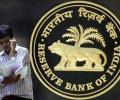
Higher for longer' may be the narrative in the developed markets, but interest rates might not stay high for very long in India, with a section of the market expecting rate cuts to begin this year. The six-member Monetary Policy Committee of Reserve Bank of India (RBI) decided to keep interest rates unchanged at 6.5 per cent in the April review - after hiking the policy repo rate in six previous meetings. RBI Governor Shaktikanta Das emphasised that the pause was only for the April policy and that the central bank was ready to act if the situation demanded.
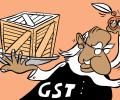
It is now becoming increasingly clear that rising imports have played a significant role in sustaining the buoyancy in revenues from GST, notes A K Bhattacharya.
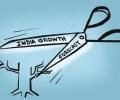
The International Monetary Fund (IMF) on Tuesday cut its projection of India's economic growth in 2022 to 6.8 per cent, as it joins other global agencies that have trimmed forecasts. The IMF had in July projected a gross domestic product (GDP) growth of 7.4 per cent for India in the fiscal year that started in April 2022. Even that forecast was lower than 8.2 per cent projected in January this year. India had grown at 8.7 per cent in 2021-22 fiscal (April 2021 to March 2022).
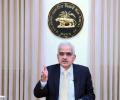
The challenge for the RBI in 2024 is likely to be less about containing elevated inflation and more about curbing excessive financial market exuberance and a 'problem of plenty', notes Sajjid Chinoy, Chief India Economist JP Morgan.

N Chandrasekaran, chairman of Tata Consultancy Services (TCS) and Tata Sons, believes that the Digital India Act is a necessity. "The Digital India Act is a necessity because so much has changed over the decades since the original Information Technology (IT) Act was put in place. I am glad the government is developing a participative approach to developing the Digital Act," he said, while answering shareholders at TCS' 27th annual general meeting. Minister of State for Electronics and IT Rajeev Chandrasekhar a few months ago had said that the government would shortly roll out the Digital India Act - a renewed policy for the digital ecosystem and cyberspace in the country.

The external environment has worsened further. While the Finnish economy entered into a recession, Swedish economic growth also dipped. The Finnish gross domestic product (GDP) dropped 0.6 per cent in October-December, 2022. It was the second quarter of negative growth, which is a technical definition of recession.
The yuan-denominated A-share market of China will become world's third largest stock market in the next ten years - after the stocks markets of United States and Japan, an expert from Goldman Sachs Group (Asia) Ltd. said.
A recession is a decline in a country's gross domestic product (GDP) growth for two or more consecutive quarters of a year. A recession is also preceded by several quarters of slowing down.
The booming Chinese economy will register a much slower growth at 8.5 per cent in 2005 compared to 9.1 per cent in 2004 due to a possible slowdown in both investment and exports, the state media reported on Friday.
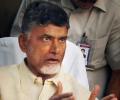
Naidu vowed to hasten the process of securing clearances by industry.

However, Icra Rating Principal Economist Aditi Nayar feels that the numbers are a bit too optimistic and need real heavy-lifting by the Centre and the states. "The survey forecasts on real and nominal GDP will require a substantial push from Central and state spending as private sector capacity expansion is anticipated to be intermittent, and sector-specific in the next couple of quarters," she said. Nayar added that private consumption is likely to chart a differentiated recovery across income and age groups. Based on the comments made in the Survey, she expects the Union Budget to incorporate a growth in gross tax revenue of 15-16 per cent.
While naysayers say the economy is on a downward spiral, optimists point out that India has experienced a shift of gears in the realm of policies, thanks to several initiatives of the Narendra Modi government, says Ashok K Lahiri.

The finance minister's assertion that industry should not expect any spectacular announcements in the 2024 interim Budget suggest that the electoral imperatives of more tax concessions or higher expenditure on welfarist programmes could be far less pronounced than they were before the 2019 interim Budget, expects A K Bhattacharya.

Government unveiled the much-awaited FTP for 2015-20 on April 1, 2015.
